


Meet Gwendolyn Post. (Trivia; Played by actress Kristin Scott Thomas’s sister.)
People say there are no stupid questions, but do they mean it?
I have a favorite story from my BlogHer days. It was during the nascent beginning of the ad-tech industry that allowed for the eventual automation (and commodification) of online advertising placement. And I was only a few years out from my time spent in the cable telecom sector, building hardware and thinking about routing, networking, and communications at the physical layer. BlogHer had a vendor of one of those new-fangled ad-tech companies presenting to us in our big conference room, and he kept using an acronym, DSP.
There’s a reason standard advice tells you to scan your remarks or decks and eradicate most jargon, buzzwords, and acronyms from your pitches. Especially when you’re operating at the cutting edge, your prospective customer may not yet know those terms. In this case, I did not know what DSP was. Or, rather, I knew what DSP was in my old telecom world…digital signal processing…but I could not figure out how that definition mapped to what the presenter was describing. It didn’t make sense, and a part of my brain was hung up on it. There was this record-scratch-y friction preventing me from really listening and understanding what he was offering.
Finally, I just raised my hand and asked. Now, I’d already trained myself out of prefacing any question I asked with “This might be a stupid question…” [Seriously, don’t do that. If not for yourself, then to model to your team that you really mean it when you say, “there are no stupid questions.”] But privately, I thought it might indeed be a stupid question.
Turns out DSP=demand-side platform in ad-tech speak. Mystery solved.
As I asked, and he answered, though, I saw every other person at that table write down the answer too, almost surreptitiously. It reminded me of how truly, deeply I believe asking the question makes you look confident and smart, not stupid. If I hadn’t been willing to ask questions when I first got into tech, I never would have climbed that ladder, because I never would have learned.
A bonus is that the subtext to asking even the obvious questions is that people think, “wow, they must really have their shit together to be comfortable enough to ask that question.” People are afraid to ask, so asking questions conveys a lack of fear.
How questions get weaponized.
I thought of this story today during my Buffy rewatch this week. An episode featured someone who spoke with utmost confidence but, ultimately, fake authority.
The Buffy backstory: A new authority figure waltzes into the Scooby Gang’s lives, full of assertions and an obvious sense of superiority. Gwendolyn Post, a new Watcher, was sent by the Watchers Council (according to her) to keep tabs on the non-traditional American crew. She comes in hot, confident AF, and everyone buys it, despite it all being a cover and a lie. Yes, even this particular Gang of people who spend a lot of time doing research, and who have seen more than ample evidence that people aren’t always what they seem. (You know, sometimes they turn out to be vampires, demons, and monsters.)
It’s all about her British accent, power suit, and peremptory ‘tude.
She steamrolls over the existing authority figure, Giles, playing on his insecurities, and while he and everyone else don’t exactly kowtow to her, they don’t question her either. Not until a lot of damage is done.
Gwendolyn Post (perusing the rather massive stacks of books in the library): "Mr. Giles - where do you keep the rest of your books?"
Giles: "I’m sorry, the…rest?”
Gwendolyn Post: "Yes, the actual library…oh. I see."
How does she achieve this bamboozlery so easily? She weaponizes questions.
She only asks them when she’s confident it will stump people and make them feel stupid. She only answers them with a tone that reinforces that stupid feeling. In this way, she shuts people down until it’s almost too late!
(She reminds me of a boss I had, whose only question if I made a mistake was, “Why did you do that?” I mean, what is there even to say? I certainly didn’t intend to do it, so why ask why? I wish I believed that it was his somewhat inept way of asking, “How did that happen, and how can we prevent the same mistake moving forward?” But I don’t think so, I think he wanted to make me feel stupid.)
What if questions are your power move?
I don’t deny people who roll in with confident, but fake, authority can fool a lot of the people a lot of the time. But who cares? That’s not who I want to be. I bet you don’t either. In a workplace environment where people are used to leaders who prefer to speak, tell, and lecture, I promise you can instead make a powerful impact by listening, asking sincere questions, and especially, not being afraid to learn from others on your team at every level.
That’s also confidence. And just like many years ago in a BlogHer conference room, it sends a message to anyone in the room that there really are no stupid questions. Confident, but humble leadership can also win the day. And, in my experience, it wins a better night’s sleep too!
Were you ever brave enough to ask a question no one else would? How’d that go for you?
Gwendolyn Post: "A demon named Lagos is coming here, to the Hellmouth.”
Giles: "What do you propose?
Gwendolyn Post: "[witheringly] If it's not too radical a suggestion, I thought we might kill him.”
Signposting and sharing
📺 Next week’s recapping will cover Buffy Season 3, episodes 9 and 10. If this week’s two episodes were about revealing of truths, the coming two are about truth’s fall-out. That’s a recurring pattern in Buffy. Hard truths. Truths revealed. Consequences. Rebuilding.
🛠️ Tool of the week/Must you create an AI agent?: This week I attended an interesting webinar about creating a “Chief of Staff” AI agent. (I went in still not really getting what an AI agent was or could do, but it’s a hot topic right now, including New York Times coverage of how a human Chief of Staff is the hot new CEO accessory.) Given I have several prompts I use in Claude on a recurring basis, it did make sense to explore whether I could automate those, rather than run them manually every day/week. Turns out I could (not without some of the usual back and forth). Once I’d done that, though, I remained unsure…do I need an AI agent? What could an Agent do for me beyond those automations I’d just done (see below for the list)? Naturally, I asked Claude. It said ultimately an Agent could be set up to regularly check the health of each of these automated tasks, in an automated way, and further it could be set up to periodically scan the output of these tasks and review them as a whole…is there some recurring problem or friction or decision I experience that I should be aware of? But, it also said, hey, don’t make that decision now…why not let these run for a few weeks and re-visit the idea of also creating an Agent. I agreed, and it set up an Apple Reminder to ping me for that review in one month. I think it’s important to point out that it would not be wise to let an AI agent be the only entity reviewing and synthesizing this info. It’s my job as a human who is not interested in dumbing myself down to do that work. The Agent could be employed to catch things I miss. So, must you create an Agent? No, I don’t think so. But you can also automate recurring tasks without an Agent, and that was a worthwhile effort for me.
📚 This week’s book commentary is about format: I’ve become a big audiobook listener. Partly because I have lots of times when I can listen…my daily walk, in the car, cooking, laundry, etc. I have finally met my match…an audiobook where I wish I had gotten the text version instead, and it’s an award-winner. I’ve read a couple of George Saunders books this year, particularly Vigil, which I enjoyed a lot, so it was a natural next step to borrow his most celebrated work, Lincoln in the Bardo. LitB won the Booker prize, and even its audiobook won the Audible Audiobook of the Year. But I’m finding it hard listening. The book is comprised of numerous historical and fictional accounts of real life events. The audiobook employs 100+ actors to bring those accounts to life. And each account, most of them quite brief, comes with the credit for who said it and in what publication. Think of it as almost like a bibliography with a sentence or paragraph per reference. And I’m finding that quite tedious to hear read aloud each and every time. I think if I were reading it, my eyes would start to glide right by those credits. The ear cannot glide by anything. It’s a very interesting and evocative novel…Recommend reading with your eyes, not your ears.
🏆 Recommendation of the Week: Passing along someone I'd recommend if you’re like me, figuring out (again) who you want to be when you grow up. Or just trying to plan out this next phase of your career, whatever level you may be at: Claire Wasserman, career coach and founder of Ladies Get Paid. She's for smart, accomplished women who are still not getting what they're worth, whether that's a raise, a promotion, a better role, or just more clarity on what they actually want. She combines real strategy (negotiation, positioning, job search) with the deeper work that most coaches skip: the nervous system patterns, the self-doubt, the things that make you freeze right when it matters most. She doesn't just coach, she gets in the work with you and builds things. A free fit call is 20 minutes and genuinely useful either way. I’ve done several sessions with Claire over the years, and I always walk away with new perspective…and new action items.
BONUS: Here’s the list of recurring prompts I was entering, now existing as scheduled automated tasks that execute without me, then wait in a sidebar chat for my perusal:

These reports now run on their own at a prescribed time.
My daily tarot card:

Today I drew The World. (First Major Arcana card in a while.) The World is the final Major Arcana card. It speaks to achievement and completion. And, given last week’s newsletter topic, it’s interesting that its third meaning can be about acknowledgment. The image on this card represents one of the few times Buffy received acknowlegment from outside the Scooby Gang, for all her work to keep the world and Sunnydale safe. This thing about The World is that it doesn’t say, OK, that’s it, you’ve achieved everything you’re going to do in life. It’s really about noting an achievement, which leaves you free to start your next journey. And I do feel like I’m at the start of a new journey!
A card pull or full reading can help make a specific decision. Or can set the tone for your week. Either way, options are here, my Buffy deck and I are at your service! https://calendly.com/elisacp
Out in the world this week:
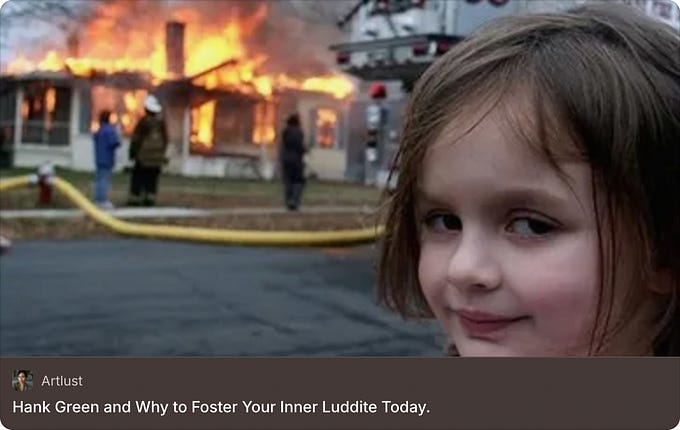
Artlust is one of my relatively new follows on Substack and Threads. History, politics, art, feminism…what’s not to like?
She recently wrote a post about the recent Hank Green AI controversy as part of a bid to “…foster your inner Luddite,’ which may not mean exactly what you think it means. It inspired me to list exactly how I think the tech bros currently in power have tried to cement status and wealth as the de facto inheritance of people just like them. And keep the rest of us out.
So, what Buffy episodes did I watch these past two weeks week?
I watched Season 3, episodes 7 (Revelations recap) and 8 (Lover’s Walk recap)…which aired on November 17 and 24, 1998 respectively.
The core #BuffyLifeLesson in “Revelations” is secrets bad, sure, but also: Hiding and secrets are part of what leads us to go it alone when we should ask for help. Secrets aren’t just toxic when they’re brought to light; they’re toxic the entire time we hold onto them.
The core #BuffyLifeLesson in “Lover’s Walk” is that sometimes the most damaging secrets are the one we keep from ourselves. Protecting ourselves from hard truths leads to fooling ourselves with hard lies. It’s not better. Being honest to yourself, about yourself is a lifelong project.
I’m here every week, using pop culture (and Buffy the Vampire Slayer right now) as a jumping off point for everything I’m thinking about professional leadership, personal development, political philosophy, and pop culture. I would love you to join me by subscribing. And I would love you to share the link with other nerds like us!
FINAL WORDS
Willow (who, most definitely, has a secret): "…you kept a secret. That's okay. Secrets aren't bad. They're normal. Better than normal. Secrets are good! Must be a reason we keep them, right?"
